Creator selection is 80% of influencer program success. Most brands get it wrong.
Four questions to answer before you look at a single follower count.
Most brands hand this decision to an agency, which runs a numbers-based shortlist: budget in, influencer list out, ranked by follower size. If they do have an in-house team, more often than not they pick the top influencers based on the budget and follower count. Either way, selection treats follower count as the main filter for picking influencers who can be part of a successful influencer program. There are critical questions that don't even get asked before you choose your influencers.
Let's look at two different selection approaches.
Uniqlo takes a high-volume, high-conversion approach with deliberate room for experimentation and optimization. Our read of Uniqlo's program is that selection spans five creator categories: global ambassadors, regional celebrities, designer collaborators, content creators, and community partners.1 Each has a distinct goal tied to specific business objectives. But across all five, the selection is anchored by high brand compatibility.
Gymshark's selection approach is the opposite: narrow, deep, and slow. Ben Francis personally picked a handful of niche fitness YouTubers when he started. The filter wasn't reach or rate card; it was personality and values. The selection filter has stayed the same ever since: does this creator's audience look like our target customer? Would they wear the product without being asked to? Even as the brand grew and could have signed anyone, it kept the bar high on brand alignment and relationship building.
Selects for scale and category coverage
While protecting brand values.
Selects for audience fit and long-term relationship potential
Narrow, deep, and slow.
Both approaches were the result of a clear growth objective mapped against real constraints like budget, internal capacity, and market complexity. Uniqlo's resources allowed for scale and experimentation across tiers. Gymshark's constraints demanded focus and intentionality. There are four key questions you need to align on before you choose the right influencers to work with.
What is the objective of your influencer program?
Before you look at a single creator profile, you need to answer this. It determines everything that follows: the type of creator you choose, how many you work with, and how you measure success.
Most programs run on one of three primary objectives:
Brand awareness
Reach as many of the right people as possible, as fast as possible.
Measure: reach and impressions across target segments
Community and loyalty
Build a base of engaged customers who come back and advocate for the brand.
Measure: engagement quality, retention, referral
Revenue and sales
Drive measurable conversion.
Measure: attributed purchases, cost per acquisition, return on spend
Programs for new market entry, product launches, or brand repositioning usually blend these three. Pick the dominant one as your primary objective and the framework below still applies. The scoring weights in Question 3 shift to match.
Most brands conflate their influencer program objective with their broader brand or business objective. An influencer program needs its own specific goal within the wider marketing strategy. Jumping to who and how much without settling that first is where the misalignment starts.
For example, a new brand might use influencer marketing for widespread reach and rely on paid media to drive conversion. A luxury brand might use it specifically to build loyalty with a younger audience. Two objectives, two very different selection approaches.
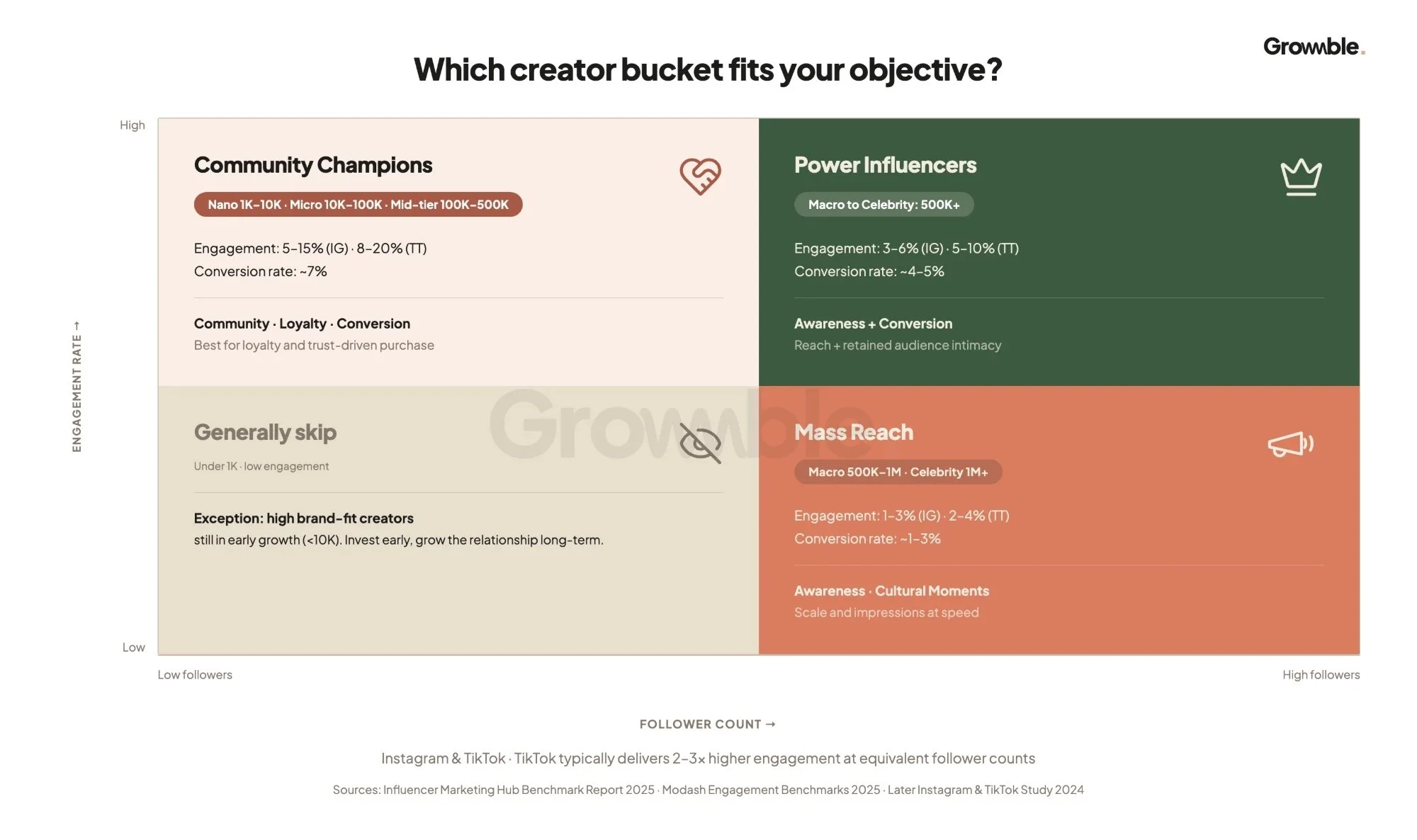
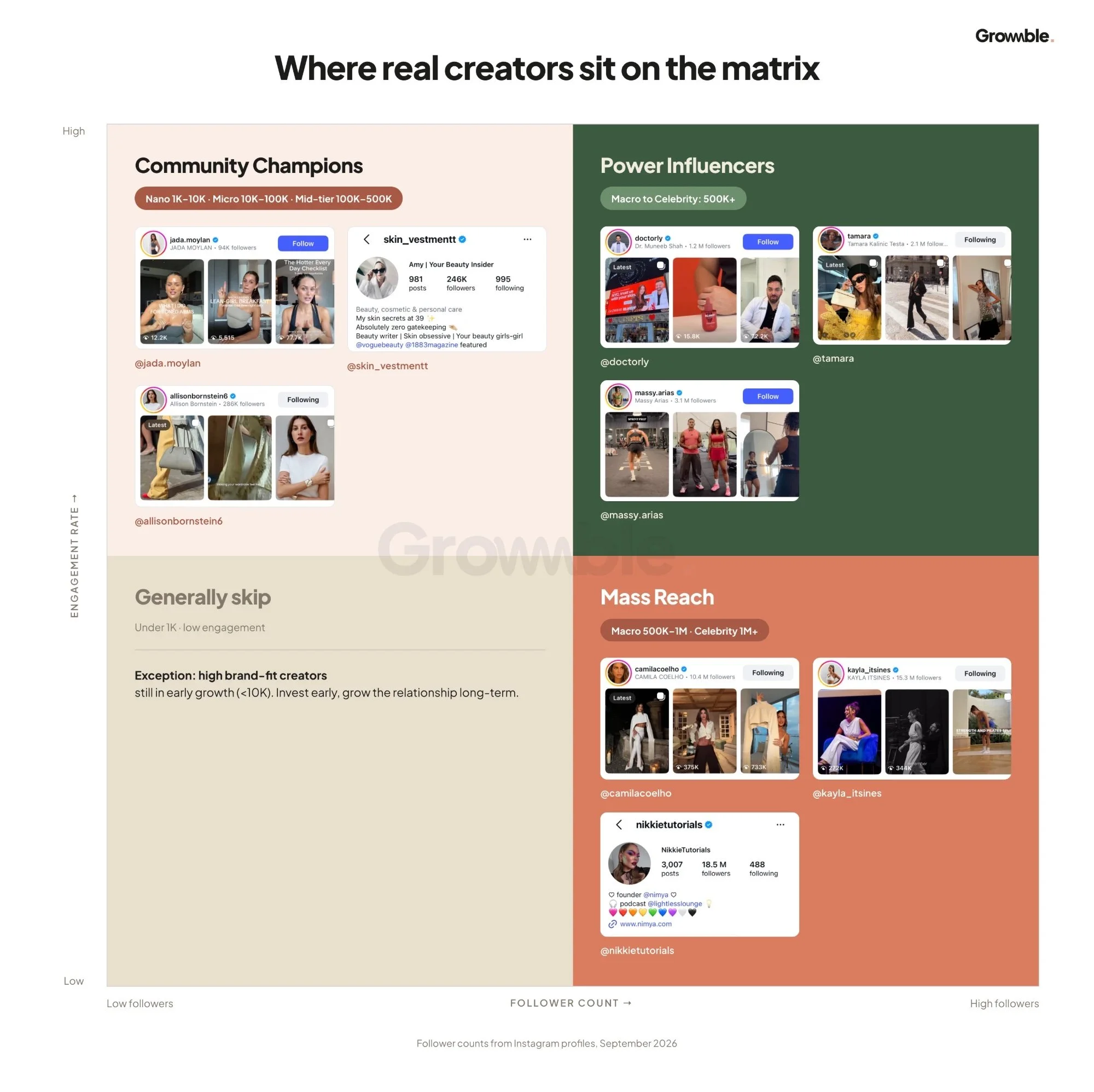
What bucket of influencers fits that objective?
The two most misunderstood variables in creator selection are follower count and engagement rate. Both matter. Brands just read them separately, and they only mean something together. Together, they map to three creator types worth knowing.
Which specific creators within those buckets?
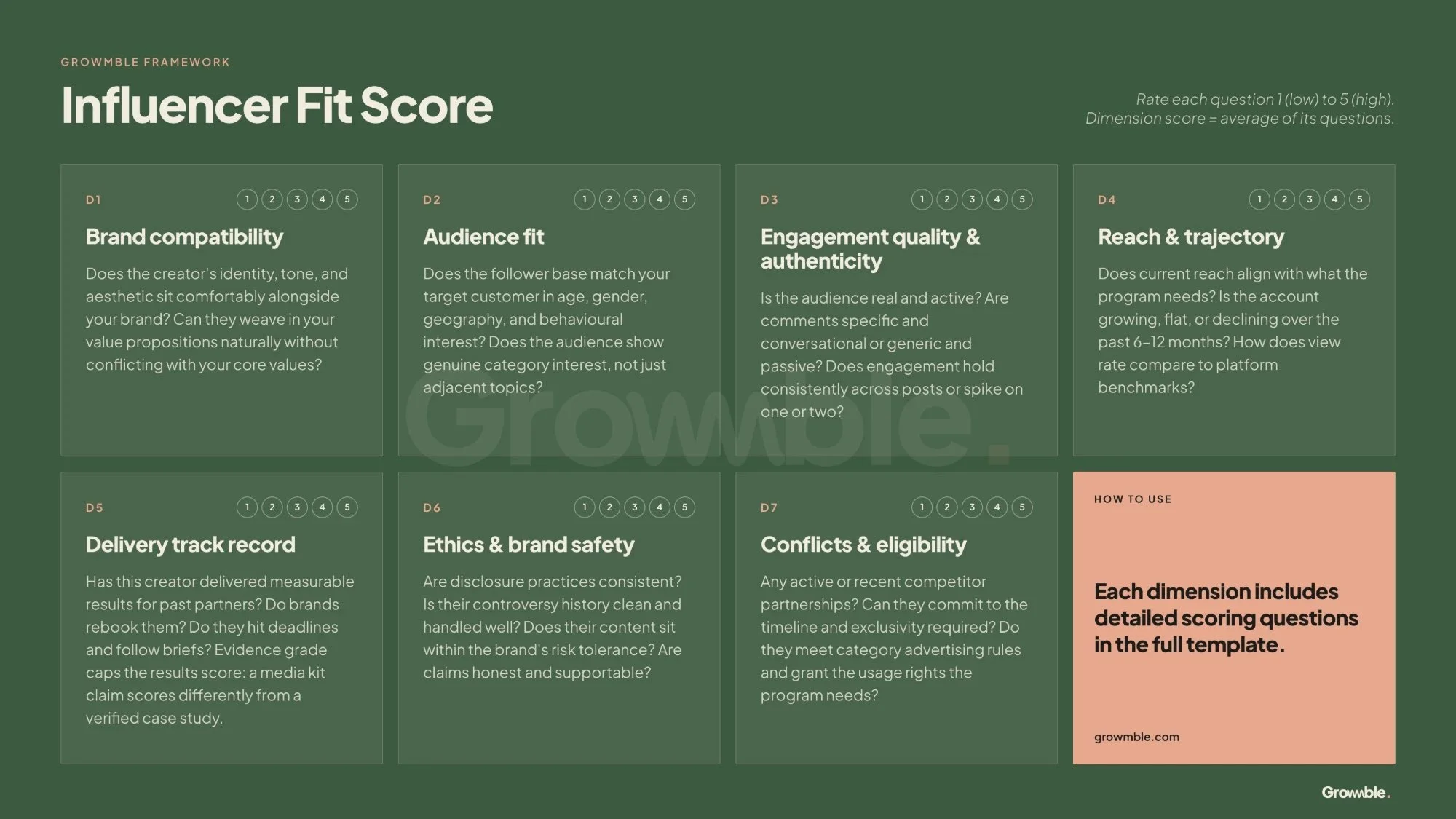
Seven dimensions filter individual creator selection. Each breaks into three to five specific questions, each scored 1 to 5 with written anchors at 1, 3, and 5. The dimension score is the average of its questions. Six of those questions are knockouts: score a 1 on any of them and the creator is out, regardless of how they score elsewhere.
D1: Brand compatibility is whether the creator's brand identity sits comfortably alongside yours. A creator doesn't need to match your brand, only avoid clashing with it. A creator with a strong humor register can make a craft brand feel more approachable without breaking what it stands for. What they can't do is conflict with your core values or break a fixed visual or verbal code. This dimension also asks whether their content aesthetic fits what the campaign needs, whether they show up in the topics and communities your brand wants to be part of, and whether they can weave in your product's value propositions naturally.
D2: Audience fit is the actual profile of who follows this creator: age, gender, geography, and behavioral interests. A creator whose audience skews 18–24 male isn't right for a product targeting 35+ professional women, regardless of aesthetic compatibility. The demographic match question is a knockout. This dimension also checks geographic market coverage and whether the audience shows genuine interest in your product category, not just something adjacent to it.
D3: Engagement quality and authenticity covers how a creator's audience actually behaves, and whether that audience is real. Audience authenticity is a knockout: an account where a significant share of followers are bots fails the dimension before the engagement questions are scored. Running the handle through an audit tool like HypeAuditor or Modash before shortlisting is a one-step catch for a risk that's otherwise invisible until after the invoice is paid. Beyond authenticity, this dimension measures engagement rate against platform benchmarks, the quality of comments (specific and conversational vs. generic reactions), buying intent signals in comments, and whether performance holds consistently across posts or spikes on one or two. Industry estimates put influencer fraud at 10–15% of engagements across campaigns.2 Engagement quality is how you avoid paying for reach that looks real but doesn't convert.
D4: Reach and trajectory asks whether the creator's reach aligns with what the program actually needs: average reach against the target, view rate relative to platform benchmarks, and growth trajectory over six to twelve months. A creator at 80K followers who has grown 40% in six months is a different asset than one at the same count who has been flat for two years. Growth signals platform algorithm favor, category momentum, and a base that keeps growing — all of which affect reach on content you haven't briefed yet.
D5: Delivery track record is the one dimension that can't be assessed from a profile. Has this creator delivered measurable results for previous brand partners: sales lift, traffic, verified conversions? Do brands book them again? Do they meet deadlines and follow a brief? Are they easy to work with from the first conversation? The results question is capped by evidence grade: a self-reported claim in a media kit scores differently from a documented case study from a brand contact. This keeps the shortlist honest about what's actually known versus assumed.
D6: Ethics and brand safety covers disclosure practices (consistent non-disclosure is a knockout), controversy history and how they handled it, whether their content sits within the brand's risk tolerance, how they treat people — critics, other creators, followers — and whether their claims are honest and supportable.
D7: Conflicts and eligibility covers commercial conflicts and legal eligibility. An active or recently ended partnership with a direct competitor is a knockout: the association sits in the audience's memory whatever the contract says, and it undermines any brand claim they make on your behalf. This dimension also checks whether they can commit to exclusivity and the campaign timeline, whether they meet category-specific advertising rules (alcohol, finance, health supplements, and so on), and whether they'll grant the usage rights the program needs.
Scoring the shortlist
These seven dimensions define the evaluation criteria. What they don't settle on their own is how to choose between five creators who all broadly fit. That call needs a consistent scoring system to be made cleanly and defended later.
Each dimension averages its questions to a score of 1 to 5. The seven dimensions convert to a weighted total out of 100. The weights shift based on the program objective: a conversion program puts more weight on delivery track record; an awareness program weights reach and audience fit higher. A knockout on any flagged question overrides the total and puts the creator into Pass.
When two creators tie within five points, use points per $1,000 of fee as the tiebreaker. Cost stays out of the fit score.
Download the full Growmble Influencer Fit Score template and Claude workflow: Growmble Pro →
How do we structure the program?
With creator type and specific selections made, the final question is operational: what program structure can your team actually run within the budget you've been given?
This is where objectives meet capacity. A two-person team on a limited budget needs a fundamentally different structure than a brand with a dedicated creator ops function and a full influencer relationship management platform. Most brands default to a structure they've seen work elsewhere without checking whether their own infrastructure can actually support it.
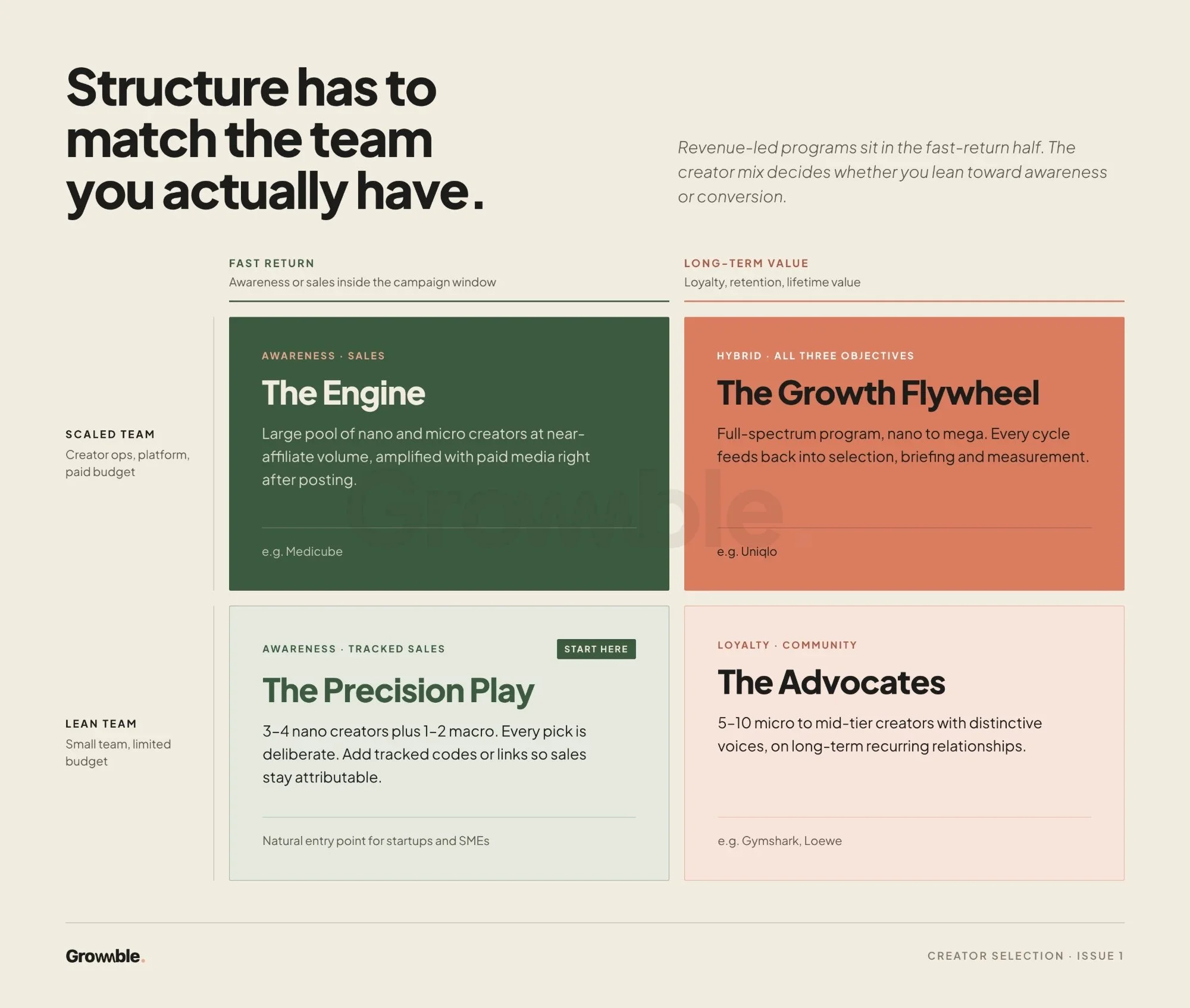
Gymshark built its program in the bottom-right of this matrix: a lean team committed to a small group of niche fitness creators their audiences already trusted. That relationship-first approach compounded over years. Uniqlo sits in the top-right: a structured program running across creator tiers and segments simultaneously, continuously refined through feedback cycles.
Different approaches. Same principle: build the structure your team can actually run.
The Precision Play (fast return, lean team): 3–4 nano creators plus 1–2 macro. Segment coverage is tight, return metrics are clear, and each round of spend funds the next. The natural entry point for startups and SMEs where budget efficiency matters as much as reach.
The Advocates (long-term value, lean team): 5–10 micro to mid-tier creators (10K–500K followers) with distinctive voices and high engagement, on long-term recurring relationships. These creators act as brand extensions: the partners you test value propositions with, bring into new product launches, and rely on to build a high-converting audience with high customer lifetime value (CLV) over time. Brands like Gymshark and Loewe have built programs this way, both defined by how tight their creator filter is: values alignment and personality fit above follower count. This approach builds slowly, converts deeply, and is hard for competitors to replicate.
The Engine (fast return, scaled team): A large pool of nano and micro creators running at near-affiliate volume, with a highly refined and scaled process. Content is amplified through paid media immediately after posting, driving fast conversion at high output cadence. The K-beauty playbook is a good example: Medicube runs this model across markets. It takes an optimized influencer relationship management process and platform, dedicated creator ops, and a paid media budget that moves in sync.
The Growth Flywheel (long-term value, scaled team): A full-spectrum creator program, nano to mega, mapped across goals and segments, and structured to improve with every cycle. Each campaign feeds back into selection, briefing, and measurement, so reach and trust grow while efficiency improves. Brands like Uniqlo run this model: a reliable selection framework continuously optimized through data and experimentation, where the program grows more effective as it scales.
Selection is the foundation
Getting the creator right is where the program starts. It doesn't end there. What you brief them on, how much creative freedom you give versus structure, how you design the first pilot, and how you define success before anything goes live: all of that determines whether the selection actually pays off.
A future issue will go deeper on briefing and pilot design. But the principle holds: the best brief in the world doesn't save you from the wrong creator.
Get selection right first.
- 1Growmble analysis based on publicly available Uniqlo creator program data. Individual elements verified: global brand ambassadors (Federer, Raducanu, Blanchett, Scott) via UNIQLO announcement: Blanchett, Aug 2025, UNIQLO announcement: Raducanu, Feb 2026 and UNIQLO Ambassador Sustainability page; designer collaborators documented across multiple collections; content creator and community partner activity via UNIQLO Lifewear Ambassadors, Social Native case study and Modash creator library. The five-category framework is Growmble's synthesis, not Uniqlo's official program naming.
- 2Influencer fraud estimate. HypeAuditor fraud detection data; CHEQ/Statista influencer fraud reports.
- 3Engagement and conversion benchmarks by creator tier (chart in Question 2). Influencer Marketing Hub Benchmark Report 2025; Modash Engagement Benchmarks 2025; Later Instagram & TikTok Study 2024; HypeAuditor Annual Influencer Marketing Report.
B2B growth strategy, brand-building, and the gap between strategy and execution.